

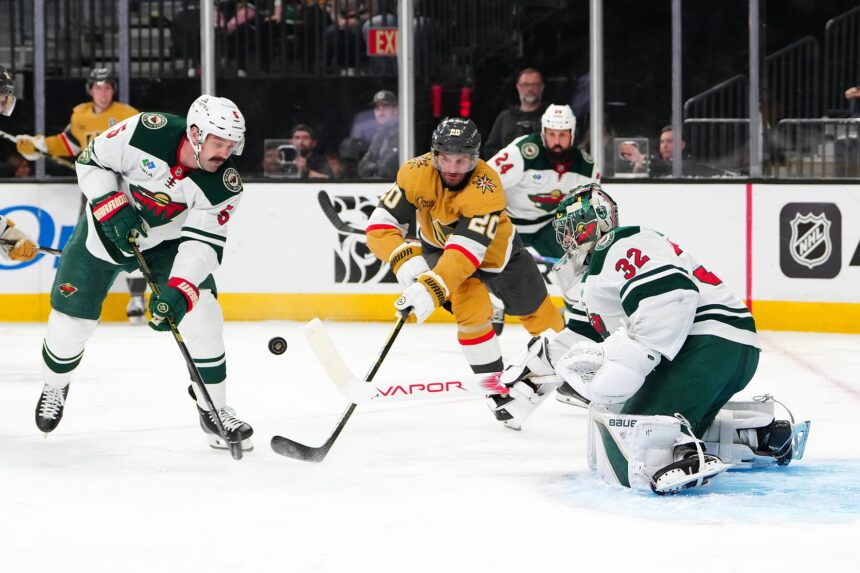
The Golden Knights have built their identity on structure. When they’re right, they close the middle of the ice, force low-danger looks, and turn stops into clean exits that feed their transition game. When they’re off, the problems don’t show up as one glaring mistake. They show up as a chain reaction: a missed assignment that turns into a second chance, a slow read that creates a seam, a failed clear that traps a tired line for another 30 seconds.
Right now, Vegas’ defensive struggles look less like a lack of effort and more like a breakdown of the details that normally separate them from the pack. The issues are fixable, but they’re also the kinds of issues that can snowball if the group starts chasing the game instead of playing it.
The Slot Is Getting Too Comfortable
Most teams can live with shots from the outside if the sightlines are controlled and rebounds are managed. The Golden Knights typically excel here, using tight layers to protect the slot and force opponents into low-percentage attempts. Lately, that interior protection has looked softer.
It starts with spacing. When the forwards sit a half-step too high in the zone, the defensemen are left choosing between stepping up on the puck carrier or staying home to protect the middle. That hesitation creates a window, and NHL offenses are too good to need more than a window. A cross-ice pass that normally gets disrupted becomes a clean look. A net-front battle that normally ends with a box-out becomes a second poke at a loose puck.
When you watch the goals against, many of them have the same feel: the first look isn’t the killer. It’s the follow-up chance created by a late stick, a lost body, or a coverage handoff that happens a beat too slowly.
Breakouts Are Turning Defensive Shifts Into Marathon Shifts
Vegas’ defense isn’t just about defending. It’s about what happens immediately after the stop. Their best stretches come when they retrieve pucks, make the first pass cleanly, and exit without drama. When breakouts get sloppy, the defensive zone becomes a treadmill.
A failed first pass is one of the most underrated sources of “defensive” problems. It keeps lines pinned, forces tired clears up the boards, and invites opponents to reload the cycle. Even strong defensive teams break when they’re forced to defend for too long, especially against opponents that can roll four lines and keep pressure constant.
This is where small decisions matter. A defenseman under pressure might rim a puck around the boards instead of making a short support pass. A winger might be late to the wall, turning a manageable play into a turnover. A center might drift too high, leaving no outlet underneath. None of these mistakes are catastrophic alone, but they stack. And once they stack, the next mistake usually happens because someone is exhausted.
If I’m betting this season (2025–26)and taking advantage of an NHL welcome bonus, I’m treating Vegas as a high-variance team: strong enough to win on talent and special teams, but shaky enough defensively that I want to be picky about when I back them.
Net-Front Details: The Unseen Battle That Decides Games
The Golden Knights have historically been sturdy around the crease. They protect their goaltender, tie up sticks, and make opponents work for second chances. During this rough patch, the net-front reliability has looked inconsistent.
Some of it is timing. If the defense is late getting inside position, they’re battling from behind rather than controlling the space in front. Some of it is communication. When coverage switches happen—especially on low-to-high plays—two players can end up guarding the same threat while another attacker slips free backdoor.
Net-front defense is also where discipline matters. If defenders start reaching instead of moving their feet, penalties follow. If they start leaning on cross-checks instead of sealing lanes with body position, rebounds stay alive. And if your goaltender is fighting through traffic without clear sightlines, even routine shots can become problems.
The Rush Defense Isn’t Matching Vegas’ Standard
The Golden Knights aren’t a passive team. Their best hockey involves activating defensemen, closing early in the neutral zone, and turning possessions into pressure. But aggressive teams have to keep their spacing clean. If one layer jumps early and the next layer doesn’t support, opponents get numbers the other way.
A lot of Vegas’ recent uncomfortable moments have come off rush situations where the backpressure is just a fraction late. That half-second can turn a controlled entry into a dangerous one. It can force a defenseman to pivot early, opening a lane for a trailer. It can also pull coverage toward the puck carrier, freeing the far-side option for a one-timer.
Rush defense is a trust system. If forwards aren’t tracking hard enough, the blue line backs off. If the blue line backs off, opponents gain the zone with speed and control. If opponents gain the zone with speed and control, you spend more time defending the slot, which is where Vegas has already been leaking.
Special Teams Stress Makes Everything Look Worse
When a team’s five-on-five structure is slightly off, special teams can amplify the damage. A penalty kill that isn’t sharp creates instant momentum swings. A power play that goes cold forces the team to “find offense” at even strength, which can lead to riskier decisions and worse puck management.
For Vegas, the defensive conversation often circles back to the penalty kill’s details: clears that don’t get all the way out, seams that open because sticks aren’t in lanes, and missed rotations on the back side. Even when the kill does its job, it can sap energy from top players and disrupt the bench rhythm. Then you return to five-on-five with tired legs and less jump in your puck support—exactly the conditions that produce the breakout issues and slot leaks that have been showing up.
The Fix Is Familiar, But It Requires Discipline
The good news for the Golden Knights is that these aren’t mysterious problems. They’re mostly the “Vegas staples” slipping: tighter layers in the slot, faster support on breakouts, more consistent net-front positioning, and better five-man tracking through the neutral zone.
The solution usually isn’t a dramatic systems overhaul. It’s recommitting to the habits that made them tough to play against in the first place. When Vegas is connected—when forwards are below the puck, when the first pass is available, when the slot is crowded and rebounds are cleared—their defense doesn’t look fragile. It looks suffocating.
And once the defensive details snap back into place, the offense usually follows. Because for this team, stops aren’t just stops. They’re the beginning of everything they want to do.